BLEACHERS
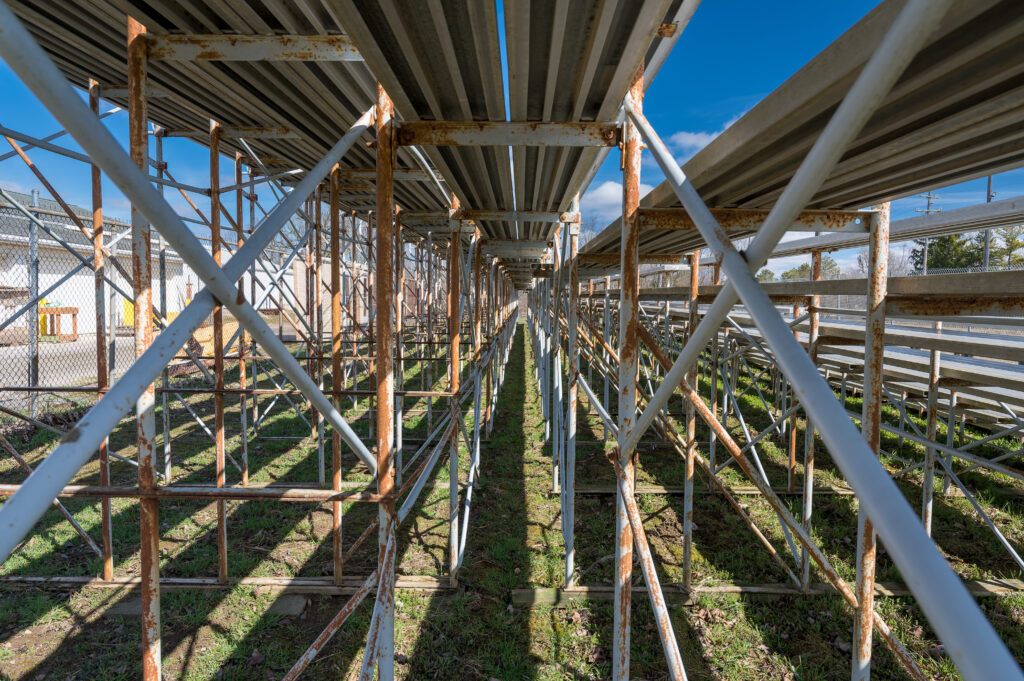
Dutch psychologists, Willem Albert Wagenaar and Jop Groeneweg wrote: “Accidents do not occur because people gamble and lose, they occur because people do not believe that the accident that is about to occur is at all possible.”[1] And the reason usually given is the most convenient of all: it can’t happen because it hasn’t happened yet.
- Here is Mayor Marlin Torgerson of Hutchinson, Minnesota, after six-year-old Toby Lee fell to his death from bleachers at the Civic Arena:
“It (the bleachers) has been here 20-something years or longer and this is the first time we’ve had a tragedy like this.”[2]
- In the above case, the Hutchinson, Minnesota attorney claimed the child fell “because he was using the bleachers as a jungle gym.”[3] However, Toby’s mother, Dawn Lee Miller recounted how her son fell through the bleachers: “My son is walking toward his mother and stumbles and falls through.” [4]
- In Coon Rapids, Minnesota, after her daughter was injured in a bleacher fall, her mother, Karen Christopherson recalled, “she (her daughter) must have leaned back and just a little bit too far and lost her balance and went through before my husband could grab her.” [5]
- In the Coon Rapids, Minnesota case, the city fathers told Karen Christopherson that “it had never happened before, my little girl was going to be okay, they didn’t see any need to do anything drastic, and they didn’t want to waste the taxpayers’money.”[6]
- In Bemidji, Minnesota, after a two-year-old girl fell 12 feet from a bleacher and was severely injured, the rink manager argued that the kids were “horsing around.”[7]
An 1989 article in Journal of Trauma by JR Hall, H.M. Reyes, M Horvat, JL Meller and R. Stein, “The mortality of childhood falls,” noted that falls represented the seventh leading cause of death in all children 15 years of age or younger, and the third leading cause of death in children 1 to 4 years old.”
“Forty-one percent of the deaths occurred from ‘minor’ falls such as falls from furniture or while playing; 50 percent were falls from a height of one story or greater; the remainder were falls down stairs.”[8]
Falls from Bleachers
Between 1980 and 1999 there were at least 10 child deaths from bleacher falls. Four of the children were under 15. In 1999 two child deaths occurred that involved falls from bleachers. A six year fell through a gap in the footboard, while a 3-year-old fell slipped between the rails of a guardrail at the back of the bleacher and fell through.[9] That same year, there were an estimated 22,100 bleacher-related injuries that were treated in hospital emergency departments. According to the U.S. Consumer Product Safety Commission (CSPC), between 1991 and 2003 there were 19 deaths due to falls from bleachers.[10]
In 1999, the Consumer Product Safety Commission published a document titled Guidelines for Retrofitting Bleachers.[11] It includes this requirement: “Any opening between components of the guardrail or under the guardrail should prevent passage of a 4-inch sphere.”[12]
Additionally, “Any opening between the components in the seating, such as between the footboard, seatboard, and riser, should prevent passage of a 4-inch sphere where the footboard is 30 inches or more above the ground and where the opening would permit a fall of 30 inches or more.”[13]
The CPSC document states the rationale for the opening recommentations: “The 30-inch surface height recommendation for limiting openings as well as having guardrails is based on the severity of injuries that can be sustained when a fall occurs from height. The 42-inch rail height recommendation is intended to prevent inadvertent falls over the railings by all but the tallest 1 percent of adults. The 4-inch opening recommendation is based on anthropometric data showing that 95 percent of all children 4 months of age and older would be prevented from completely passing through a 4-inch opening. The 1.75-inch measurement for openings in guardrail in-fill is based on the foot width of a young child and is intended to reduce the potential to gain a foothold.”[14]
As discussed a few paragraphs earlier, there were two child deaths from bleacher falls in 1999. One of them was 3-year old Marissa Rose Trevino who fell from the top of bleachers Section 211, Row T inside the Convocation Building at the University of Texas at San Antonio. The occasion was a “Shrimp Fest” organized by Oak Hills Rotary Club of San Antonio. A preliminary report by UTSA Police Officer D.L. Garza stated:
- The bleacher side railings are loose from wear and tear;
- The width between each bleacher side railing is approximately 9-1/2 inches making it possible for a small child to go between the bars
- Section 211, Tow T, platform board is not even with the other attached boards on either side. The middle platform board between seats 3 and 4 is slightly warped than the other boards therefore allowing the attaching boards to protrude slightly and possibly causing someone to trip.
The child slipped between the bars of the railings and fell approximately 17 feet striking the metal bar along side the “Hydro-Rib Storage Area” cage which houses the free weights that are used by the UTSA population. the child then fell down another 9 feet, striking the padded cement floor.”[15]
A subsequent investigation by engineer L.D. Ryan found that the bleacher railings consisted of vertical bars spaced on 9-1/4 inch centers, thus allowing an 9-1/4 inch gap between the railings. This was more than enough to allow a child to slip through. [16]
Additionally, Dr. Ryan also discovered that there was no floor at the point where the body contacts the railing. As he said in his report, it was “like having a hole in the floor at the end of each deck-board—if a child should lean against the 8-inch end rail, there is nothing under the child’s feet.”[17] Ryan noted the importance of this anomaly in his report:
“The end rail design originally was a fixed two-rail design. The next evolution was the nominal 8-inch gap vertical end rail, and finally, the nominal 4-inch gap. The old style end rail kept the person’s foot from inadvertently stepping or slipping off the end of the deck board. If the foot did slip off, the body of the person would fall inward toward the deck. With the 8-inch gap in the vertical self-storing end rail, the person’s foot slips through, causing the body to move outward over the edge of the deck board. With the wide 8-inch gap, a child can fall through.[18]
The CPSC Bleacher Retrofit document was last published in 1999. There is no update listed.
[1] Wagenaar and Groeneweg, “Accidents at sea: multiple causes and impossible consequences,” International Journal of Man-Machine Studies,” 27, 1987. pp. 587-98.
[2] Smith, Jeff. WCCO News. Channel 4000.com. “Hockey Rink Death Fuels Questions.” Feb 9, 1999.
[3] Ibid. Quoting WCCO News staff writer Jeff Smith.
[4] Ibid.
[5] Ibid.
[6]WCCO.com. Dimension: Unsafe Bleachers. Feb 14, 1999.
[7] Ibid.
[8] Hall, JR et al “The Mortality of Childhood Falls” J. Trauma Sep 29, 1989 pp 1273-5.
[9] https://www.cpsc.gov/s3fs-public/330.pdf
[10] Fickes, Michael. “Bleacher Safety” Spaces4learning: Impacting K-12 & Higher-Education Environments” << https://spaces4learning.com/articles/2006/04/01/bleacher-safety.aspx>>
[11] U.S. Consumer Product Safety Commission, Washington, DC 20207 Pub No. 330 000011.
[12] Ibid. p. 5.
[13] Ibid. p. 6.
[14] Ibid. p. 6.
[15] Ibid.
[16] Ryan, LD PhD, PE; Preliminary Update Report Draft. Trevino v. Hussey. Ryan Engineering File A00-025. Nov 21, 2000. p. 1.
[17] Ryan. pp. 2-3.
[18] Ibid. p. 6.